Not long ago, someone who knew I worked in dentistry asked me a simple question: “Should I see an oral surgeon or a periodontist for my dental implants?” Without hesitation, and perhaps with some professional bias, I answered, “You should see an oral surgeon.” But later that day, I found myself thinking about my response. Of course, I know my own capabilities as a surgeon. I know the depth of my training and the outcomes I can deliver. But was that really the best answer for her? Is an oral surgeon always the right specialist for implant care? Or might a periodontist be better in some situations? And more importantly, was I even asking the right question? That moment gave me pause. Because the truth is, in modern implant dentistry, the answer is no longer as simple as choosing between an oral surgeon and a periodontist.
Patients who are missing teeth and considering dental implants usually want very simple things. They want to eat comfortably again. They want to smile without hesitation. They want to live healthier, more confident lives. What they don’t usually think about is who, exactly, is best qualified to place their implants.
Some patients begin their journey with a general dentist who may offer implant treatment, though general dentists do not undergo the same formal, accredited surgical training as specialist surgeons. Others are referred to surgical specialists such as oral surgeons or periodontists. But even when patients recognize that implant placement is an intricate surgical procedure requiring advanced training, they rarely understand the differences between the specialists involved. Many don’t know who the right person is to see, or why it matters.
Oral Surgeon or Periodontist: Does It Matter?
Patients who seek out specialists are often told they should see either an oral surgeon or a periodontist. Both specialties place dental implants. Both are highly trained. Yet most patients, and even most dental professionals, don’t truly understand how their training, philosophy, and scope of practice differ.
Historically, oral and maxillofacial surgeons were considered the experts in bone grafting, complex implant surgery, and managing advanced anatomy. Periodontists, on the other hand, were viewed as the specialists best suited for gum tissue grafting, soft-tissue management, and implants in the aesthetic zone. There was also a saying many of us heard, perhaps once true, but now far from reality, that oral surgeons had the “rough hands,” while periodontists had the “delicate hands.”
Over the last 20 years, however, implant dentistry has evolved dramatically. The two specialties have advanced, overlapped, and converged in many important ways. There has been extensive collaboration, shared research, and cross-pollination of literature between the two disciplines. Yet the perception of how each specialty practices implant dentistry has not evolved nearly as much. Many still believe oral surgeons are ideal for “big grafts” and difficult surgical cases, while periodontists are better suited for soft-tissue and aesthetic concerns. While there may be some historical truth to these assumptions, they no longer tell the whole story.
The reality is that there is a wide range of skill, experience, and philosophy within both specialties, and that variability can create real problems for patients. A patient treated by a traditionally trained oral surgeon may receive excellent bone grafting and solid implant placement, yet end up with disappointing aesthetic results because soft-tissue factors were not fully considered. Conversely, a patient treated by a traditionally trained periodontist may achieve beautiful gum contours but have less-than-ideal bone support or implant positioning, compromising long-term stability.
Implant dentistry does not forgive imbalance. You cannot neglect bone biology. You cannot ignore soft tissue. You cannot separate surgery from prosthetics. Success requires all of it, working together.
As an oral and maxillofacial surgeon, I can say this candidly. My training emphasized bone management, anatomy, and surgical execution. We became excellent at grafting, implant placement, and managing complexity, but we spent relatively little time developing advanced soft-tissue skills, prosthetically driven implant positioning, or digital workflows.
Looking back, I realized something uncomfortable but important: I was only half of an implant surgeon.
Recognizing this gap changed my career. I made a deliberate decision to learn “the other side” of implant dentistry, soft-tissue management, aesthetics, digital planning, restorative principles, and interdisciplinary thinking. Over time, I complemented my surgical foundation with a broader, more integrated skill set. That is when I began to feel like a complete implant surgeon.
Why Specialty Matters Less, and Mastery Matters More
Today, I believe that in modern implant dentistry, a surgeon’s specialty title matters far less than it once did. What matters is whether the surgeon understands biology and healing, anatomy and physiology, hard-tissue and soft-tissue management, ideal implant positioning, digital diagnostics and planning, and restorative outcomes and long-term maintenance.
It is this comprehensive, end-to-end understanding that creates remarkable outcomes, and that is what patients ultimately care about. Patients don’t want an “oral surgeon implant.” They don’t want a “periodontist implant.” They want implants that look natural, function comfortably, respect anatomy, preserve biology, and last for decades.
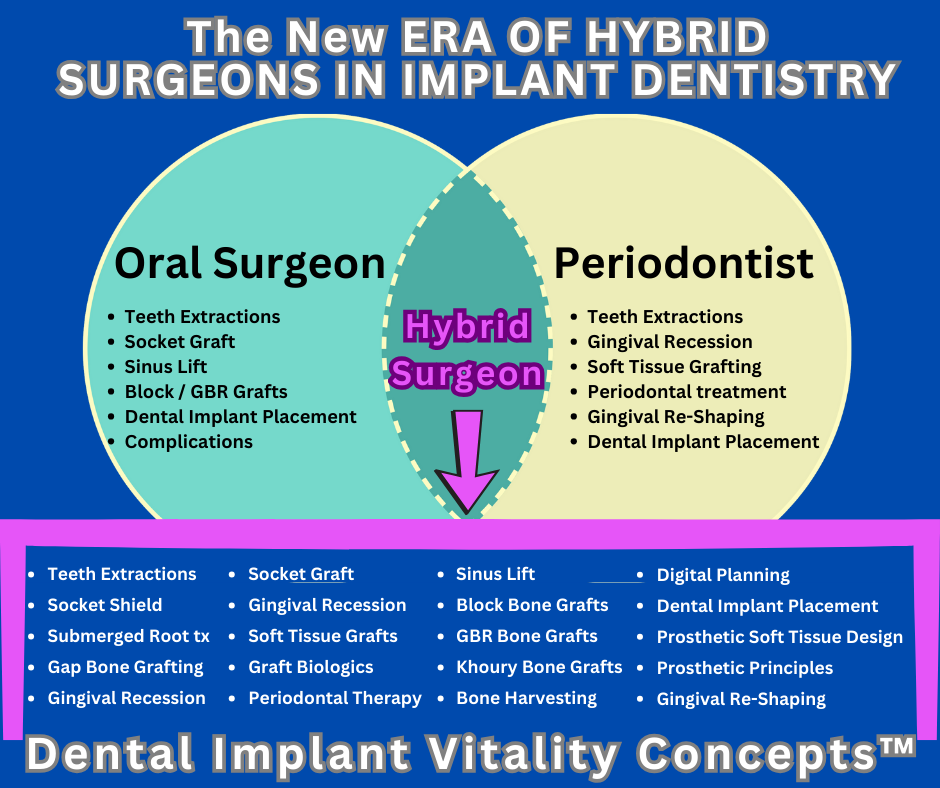
Enter the Hybrid Surgeon
This is where the concept of the hybrid-surgeon emerges. A hybrid-surgeon is not defined by a specialty label. Instead, they combine the surgical depth of an oral surgeon, the soft-tissue expertise of a periodontist, and the restorative and aesthetic perspective of a prosthodontically minded dentist.
To understand how this “hybrid” shift moved from theory to reality, one must look at the impact of platforms like DentalXP. Founded by Team Atlanta, the Salama brothers, and Dr. Maurice Salama, the platform became a digital town square where the rigid silos of “the oral surgeon” and “the periodontist” began to crumble.
Dr. Salama noticed this silo problem years ago, when a surgeon might place an implant perfectly into the bone, only to have the restorative dentist struggle because the gums were too thin or the angulation made the restoration difficult or impossible to clean. It was a “pass-the-baton” style of medicine that often left gaps in patient care.
Complex challenges in healthcare are best solved through deeper understanding and collaborative learning. DentalXP, as Dr. Salama describes, changed the game by broadcasting high-definition, real-time surgeries that prioritized interdisciplinary planning. He saw how the curriculum helped “pure” oral surgeons realize that bone grafting alone is not enough, and that mastery of periodontal and soft-tissue principles is equally essential, and vice versa.
The result, as he puts it, was the birth of the modern hybrid practitioner. Through centralized, high-level sharing of “trade secrets,” a new generation of clinicians emerged, oral surgeons by training with the delicate hand of a periodontist, and periodontists by training with the advanced bone-building skills of an oral surgeon.
Platforms like DentalXP essentially democratized the “secret sauce” of elite Beverly Hills or European clinics, making it a global standard. The question shifted from “Is the implant tight?” to “Is the architecture biologically and esthetically perfect?” For many clinicians, a true lightbulb moment occurred during DentalXP’s global symposiums. A surgeon who had spent decades focused on the “heavy lifting” of maxillofacial reconstruction might watch a masterclass on soft-tissue management and realize how a simple tunneling technique or rotated palatal flap could prevent an implant from appearing as a grey post beneath the tissue.
As Maurice Salama succinctly puts it: “Today, successful implantology requires a hybrid approach. A practitioner must be as skilled in the macro-stability of bone, the surgeon’s traditional wheelhouse, as they are in the micro-biology and esthetics of the gingival margin, historically the periodontist’s domain.”
The hybrid surgeon understands implant dentistry from A to Z, from diagnosis and planning to surgery, tissue management, restoration, and long-term success. Hybrid surgeons deliver implant restorations that are aesthetically compatible, functionally sound, anatomically precise, and biologically stable. Most importantly, they deliver outcomes that allow patients to simply get back to living their lives.
Becoming a hybrid surgeon requires intentional evolution. It begins with a surgical specialist, whether an oral surgeon or a periodontist, who is willing to fully immerse themselves in the other discipline. That means reading each other’s literature, attending each other’s conferences, and engaging in honest, peer-to-peer dialogue where ideas and expertise are exchanged freely. The era of “protecting my specialty” or guarding knowledge as territory must give way to collaboration.
Equally important, the hybrid surgeon must embrace the restorative side of implant dentistry, understanding prosthetic principles, aesthetics, and how surgical decisions must align with the restorative dentist’s vision for creating beautiful, functional teeth. Ultimately, this path requires humility: the willingness to admit that no one knows everything, to relearn like a student, and to remain open to continuous growth. Mastery in implant dentistry is not a destination, it is a lifelong endeavor.
It is time to move beyond outdated distinctions. Patients should no longer ask, “Are you an oral surgeon or a periodontist?” They should ask, “Are you a complete and formally trained surgeon, and can you give me an implant and a tooth I’ll truly love?” The future of implant dentistry belongs to hybrid surgeons and restorative dentists working as a team, clinicians who integrate disciplines, embrace lifelong learning, and treat implant dentistry as a complete biological and restorative system. For patients seeking implants today, that distinction will make all the difference.
Implant dentistry is no longer about isolated procedures, protected territories, or specialty silos. It is about responsibility, to biology, to aesthetics, to function, and ultimately to patients’ lives. The future belongs to clinicians who refuse to think partially, who see implant care as a complete system rather than a sequence of steps. Hybrid surgeons are not defined by titles, but by mindset: curious, humble, interdisciplinary, and relentlessly committed to mastery. They measure success not by whether an implant integrates, but by whether a patient feels whole again. This is not a trend. It is a necessary evolution, and it is redefining what excellence in implant dentistry truly means.
Dr. H. Ryan Kazemi is a board-certified ‘hybrid’ oral & maxillofacial surgeon in Bethesda, MD.