Few dental decisions cause as much second-guessing as what to do about wisdom teeth. Should they stay or go? Is surgery really necessary if nothing hurts? To cut through the noise, it helps to look at guidance from oral surgeons, as we manage treatment surrounding these teeth every day.
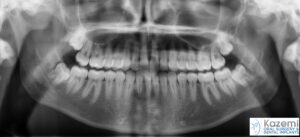
Four wisdom teeth: 1, 16, 17, 32. The position and angulation of the teeth at this age already tells us that these teeth will be non-functional, and can only cause problems if not removed.
Reason 1: Wisdom teeth cause a well-documented list of problems
Since wisdom teeth are the last teeth to come in, and often the most crowded and hardest to clean, they are prone to a familiar set of issues:
- Pericoronitis: painful gum infection around a partially erupted tooth.
- Tooth decay: in the wisdom tooth itself and, just as often, in the healthy second molar right next to it.
- Gum (periodontal) disease: the deep, hard-to-clean pocket behind a wisdom tooth can trap bacteria.
- Cysts and tumors: imaging can sometimes reveal cysts or tumors associated with these teeth.
- Damage to neighboring teeth: impacted teeth can push against and harm the roots of the tooth in front of them.
When disease is already present, the recommendation is that the wisdom tooth comes out. This also improves the health of the adjacent teeth.
Reason 2: The procedure gets harder and riskier with age
According to the research completed by the American Association for Oral and Maxillofacial Surgeons (AAOMS) on wisdom teeth removal, ”evidence clearly indicates that surgery is more difficult as patients age, with an “increased rate of complications” for older patients.
In younger patients, the roots of the wisdom teeth aren’t fully formed, the surrounding bone is more forgiving, and healing tends to be faster and smoother. As patients get older, roots lengthen and anchor deeper, bone becomes denser, and recovery can be longer and more complicated.
That’s why AAOMS recommends making a decision to remove or continue to observe before the middle of the patient’s third decade, meaning by the mid-20s. Waiting until a wisdom tooth becomes an emergency often means facing a tougher surgery at a less convenient time in life.
Reason 3: Removal is favored in several common situations
Beyond active disease, the AAOMS lists specific circumstances where removal is the favored choice even before symptoms appear:
- The tooth is (or is likely to become) non-functional, i.e., it isn’t doing the job of chewing and has no clear purpose.
- There’s an overlying removable prosthesis, e.g., a wisdom tooth under a denture can cause ongoing problems.
- Orthodontic reasons justify it. For example, when a wisdom tooth is blocking the eruption of the second molar or complicating orthodontic treatment.
- Orthognathic (jaw) surgery is planned. Removing third molars is often part of preparing for corrective jaw surgery.
In each of these cases, taking the tooth out early prevents a predictable future complication rather than reacting to one.
Reason 4: You often can’t predict the future so watchful waiting has real risk
The hardest calls involve asymptomatic, disease-free wisdom teeth. Because “we cannot confidently predict what the future holds” for these teeth, the decision relies on an experienced clinician’s judgment about how likely problems are to develop.
Choosing to keep a wisdom tooth isn’t a one-time decision. It’s a commitment to ongoing monitoring, with X-rays and exams over the years, and the understanding that treatment may still become necessary down the road, potentially when it’s harder to perform. For many patients, addressing the tooth proactively while surgery is simpler and recovery is quicker is the lower-risk path overall.
What this means for you
So what does this all mean? Patients need a thorough exam, honest conversation about the risks of removal and retention, and a plan tailored to you. Some patients who keep disease-free wisdom teeth may go their whole lives without trouble, but the only way to know where you stand is to be evaluated by a qualified oral and maxillofacial surgeon, ideally before your mid-20s.
If you haven’t had your wisdom teeth checked, now is the ideal time. A quick consultation and set of images can tell you whether your third molars are low-risk teeth to monitor, or ones you’ll be glad you addressed early, rather than during a painful emergency.
Ready to find out where your wisdom teeth stand? Schedule a consultation with Dr. Kazemi or Dr. Sarva today.