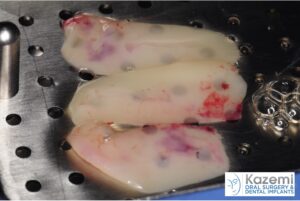
PRF membranes, created from a patient blood sample that was centrifuged with no additives.
What is PRF?
PRF stands for platelet-rich fibrin. It’s a second-generation “platelet concentrate” made entirely from your own blood. This means no additives, no chemicals, nothing synthetic.
The process of creating PRF is quick and takes place right in our office. We draw a small amount of your blood, much like a routine lab test, and spin it in a centrifuge for a few minutes. That spinning separates the blood and concentrates healing components such as platelets, white blood cells, and fibrin. The result is a soft, gel-like clot that is rich in the body’s own repair mechanisms. We then place that PRF directly into the fresh extraction socket, where it acts as a natural, living bandage.
Because PRF is made from your blood, it’s completely biocompatible. There is no risk of rejection or allergic reaction, and no foreign material is involved.
Why does PRF work so well?
Platelets do far more than simply help blood clot. They’re packed with growth factors, which are proteins with names like PDGF, TGF-β, VEGF, and IGF. These factors signal your body to build new blood vessels, form soft tissue, and regenerate bone. PRF concentrates these growth factors and, thanks to its fibrin structure, releases them slowly over the following days, right when your surgical site needs them most.
The fibrin itself is just as important. It forms a three-dimensional scaffold that stabilizes the blood clot and gives new cells a structure to grow into. A protected, well-organized clot is exactly what a healing socket needs.
What does the research show?
PRF has been studied extensively in oral surgery, including in a number of systematic reviews and meta-analyses. Here’s what the research shows:
Fewer dry sockets. Dry socket (alveolar osteitis) is one of the most painful complications after an extraction, happening when the protective clot is lost too early. Multiple meta-analyses have found that placing PRF significantly lowers the risk of this happening. One analysis of lower wisdom tooth extractions reported that the incidence of dry socket dropped by roughly two-thirds in PRF-treated sockets compared with those left to heal on their own. PRF has even been studied as a treatment for dry socket once it occurs.
Less pain and swelling. PRF supports a stable clot and enhances the healing process, so patients often report a more comfortable recovery. Pooled data from randomized trials show statistically significant reductions in post-operative pain and swelling in the days after surgery when PRF is used.
Faster, healthier soft-tissue healing. The growth factors in PRF encourage the gum tissue to close over the socket more quickly, which can mean a cleaner, more predictable recovery.
Support for bone and ridge preservation. After a tooth comes out, the surrounding bone naturally begins to shrink. PRF has been studied as an aid in “ridge preservation” by helping maintain bone volume and density in the socket. This matters especially if you’re planning a dental implant later, since a healthier, fuller ridge makes future implant placement more straightforward.
It’s low-cost, natural, and low-risk. There’s no synthetic graft material and no donor tissue. It just requires a few minutes of processing your own blood. That makes PRF an appealing option with a very favorable safety profile.
Is PRF right for your extraction?
PRF can be especially worthwhile for surgical extractions, impacted wisdom teeth, patients who are prone to dry socket, and anyone planning an implant where preserving bone is a priority. Because it uses only your own blood, it fits comfortably into most treatment plans.
If you have an extraction coming up, ask us whether PRF makes sense for your situation. In just a few extra minutes, we can put your body’s own healing power to work for a smoother, and more comfortable recovery.